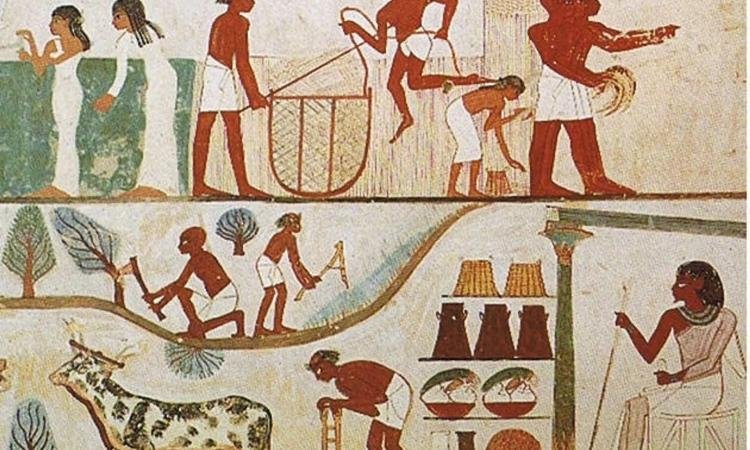
During the Eighteenth Dynasty, spanning the reigns of Pharaoh Thutmose I to Amenhotep III, painting achieved extraordinary fluency and expressive richness. Not surprisingly, the construction of the necropolis for the nobility near Thebes mirrored the custom, initiated by the pharaohs during the Middle Kingdom, of building their eternal abodes deep within the Valley of the Kings and the Valley of the Queens. Indeed, the proliferation of tombs enabled the development of painting on walls and ceilings, which were plastered with stucco to even out any irregularities and thereby ensure complete adhesion of the pigment. In the funerary chambers of the nobility, painting became almost an art form in its own right, putting to the test all the resources accumulated by tradition. It is in these private tombs that a desire for expressive freedom is manifested, reflecting a taste for luxury and festivities; the depiction of the female body is also notable.Contact with Asian peoples also introduced new elements, such as an interest in detail and a penchant for more ornate forms. Shapes become more stylized, and the impression of movement in the bodies, which are also more graceful, is heightened. In the tomb of Djeserkasereneb, there is a scene depicting maids grooming a guest for a festive banquet. In the composition, the natural pose of the maid's bent body and the offering of necklaces stand out. The colors have been subtly enhanced. Pigment is no longer applied in a flat, opaque layer; instead, midtones create smooth tonal gradations, giving way to translucent areas. Detail permeates the depiction with descriptive meticulousness in the dresses and hairstyles; even the braids can be made out. The abundance of paintings demonstrates that the virtuosity of the depictions and the greater freedom of expression always depend on the subject and the painter's skill, as not all tombs exhibit the same level of achievement. Some paintings reveal much greater skill in execution, such as those in the tomb of Nakht, where the female figures are depicted with a lively and unrestrained rendering, as can be seen in a fragment depicting a group of female musicians.Movement is expressed in the nude body of one of the young women, accentuated by the direction of her head, which is turned in the opposite direction and is even indicated by the “vibrant” lines of her hair braids turned in the opposite direction, a movement even indicated by the “vibrant” lines of her braided hair. The dynamism of this figure is striking, as the other figures adopt a static pose. New themes from funerary ceremonies are introduced. Thus, the preparation of the objects that make up the funerary trousseau, the boat journey with the deceased, the farewell to the deceased, and the mourners – groups of women who accompanied the funeral procession, weeping inconsolably – are depicted. In Ramose's tomb, one of these groups is depicted wearing bluish robes crisscrossed by sinuous lines running lengthwise, which creates a sense of trembling and accentuates the bodies' expression of pain. Deeply grieved, the mourners raise their arms to the sky in supplication to the gods, while thick tears stream down their faces. The decorations in the pharaohs' tombs in the Valley of the Kings do not reflect the same expressive freedom evident in the tombs of the nobility. The themes are more esoteric, of a religious and astronomical nature. In the tomb of Pharaoh Horemheb, the last ruler of the Eighteenth Dynasty, large figures of deities parade with the rigidity of ancient forms. The walls and ceiling are completely covered by polychromy in bright, flat colors and ornamental exuberance. In the tomb of Seti I (Nineteenth Dynasty), constellations run along the ceiling of the burial chamber beneath the protective body of the goddess Nut.